


 Search



Now you can enjoy New Orleans-Style Beignets without leaving the comfort of your home! If you’ve never enjoyed these soft and pillowy fried doughnuts before, you’re in for a treat. Because this is the best fried beignet recipe! Serve beignets warm, with plenty of powdered sugar!
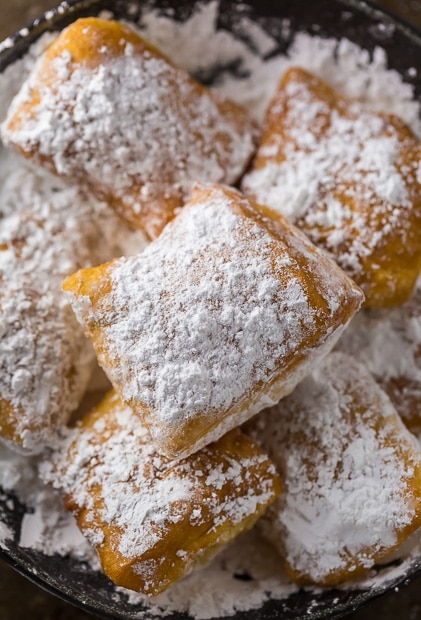
Copycat Café du Monde Beignets
We’re heading to New Orleans for vacation today and I couldn’t be more excited to chill out in the big easy! Give me all the fried dough, boozy iced coffees, and gumbo, please and thank you!
But before we head to the airport, I’m popping in to share my favorite deep fried beignets recipe with you. Aka copycat Café du Monde beignets, which are the best in New Orleans.
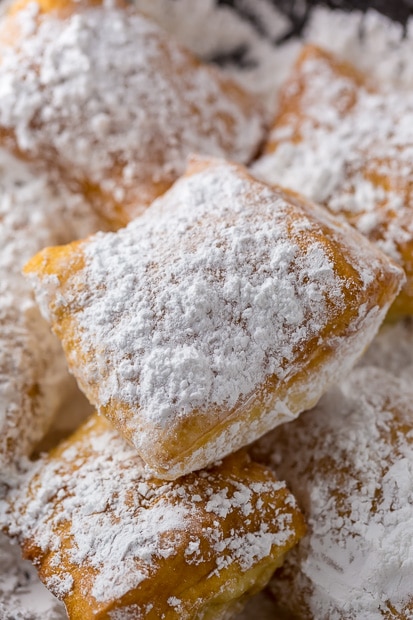
They fry up crispy, chewy, and golden brown! And you serve the beignets warm, covered in powdered sugar, with piping hot coffee. Sweet enough to be dessert but we love making these for breakfast or brunch!
What is a Beignet?
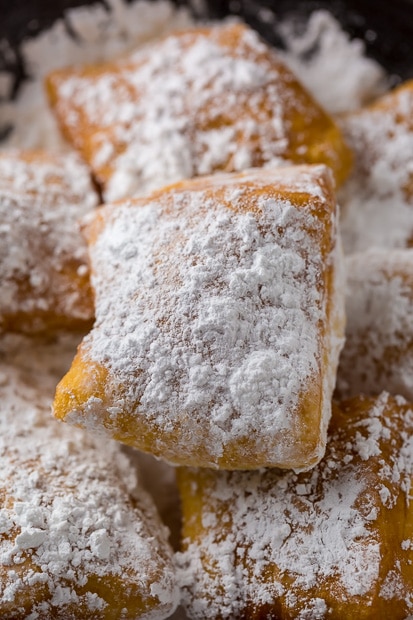
To put it simply, beignets are square shaped pieces of dough that are deep fried and generously sprinkled with confectioners sugar.
- Leftovers taste ok at room temperature, but they don’t hold up well over time.
- The word beignet is French, and translates to fried dough or fritter.
- Unlike traditional doughnuts, they have a unique square shape.
- Texture wise, they’re crispy on the outside, with an airy pillowy soft interior.
- When it comes to taste, they’re not overly sweet. Which is why they’re served covered in lots and lots of powdered sugar.
- Best served hot, with a cafe au lait or cup of coffee.
- You’ll need a deep fry thermometer for this recipe. Because if your hot oil temperature is off, your fried dough will be too. This is the candy thermometer I use, and I love it. It costs me less than 10 bucks, and I’ve probably used it over a hundred times!
- To proof the yeast mixture, your warm water should be between 110 and 115 degrees (F). If the water is too hot, it will kill the yeast cells, and if it’s too cold, the yeast will remain dormant and the dough won’t rise.
- This recipe requires bread flour. Bread flour is a high-gluten flour that has a tiny amount of barley flour and vitamin C added. The barley flour helps the yeast activate. The vitamin C increases the elasticity of the gluten and its ability to retain gas as the dough rises.
- The dough will double in size as it rests. Refrigerate the dough for at least 2 hours so it has time to properly develop.
- Fry the dough working in batches. If you crowd the oil, the beignets won’t get crispy or golden brown.
How to Serve Beignets
- As soon as you see the fried dough has achieved a golden brown color, remove them from the oil.
- Transfer them to a paper towel lined baking sheet to absorb some of the oil.
- Once cool enough to handle, transfer them to a large platter.
- Cover with powdered sugar and serve beignets warm!
As mentioned a few times earlier, I don’t suggest saving these for a future use. They get soggy after a few hours. So they’re best eaten right after making!
More Beignet Recipes:
If you can’t make it to New Orleans this year to enjoy cripsy golden brown fried dough… give it a try at home! Full step-by-step recipe video in the recipe card below!

New Orleans-Style Beignets
Ingredients
- 1 and 1/2 cups warm water, between 110 and 115 degrees (F)
- 2/3 cup granulated sugar
- 2 and 1/4 teaspoons active dry yeast
- 2 large eggs, at room temperature
- 1 cup evaporated milk
- 2 and 1/2 teaspoons pure vanilla extract
- 7 cups bread flour
- 1 and 1/2 teaspoons salt
- 5 tablespoons unsalted butter, at room temperature
- 4 cups peanut oil, for deep frying
- 2 cups confectioners’ sugar
Instructions
- In a medium-size bowl, add the warm water, sugar, and yeast and whisk well to combine. Sit aside for about 10 minutes, or until the mixture has bubbled up and become foamy.
- In the bowl of a stand mixer fitted with the paddle attachment, beat the eggs until smooth. Beat in the vanilla and evaporated milk. Beat in 3 and 1/2 cups of the flour until smooth. Turn the mixer to low speed and slowly pour in the yeast mixture (careful here – this mixture can splash up if added to quickly!); beat until smooth. Add in the butter and beat until incorporated. Finally, beat in the remaining 3 and 1/2 cups of flour and salt. Beat until dough is smooth and cohesive; about 2 minutes. Cover the bowl tightly with plastic wrap and refrigerate the dough for at least 2 hours, or up to 24 hours.
- Line a large rimmed baking sheet with three layers of paper towels, set aside.
- In a large enameled cast-iron pan, heat 4-inches of oil to 360 degrees (F). Remove the dough from the refrigerator. On a lightly floured surface, roll the dough out into a 1/4-inch thick rectangle. Cut the dough into 2 and 1/2-inch squares.
- In batches, fry the dough until they puff up and are golden brown in color, about 1 minute. Using a slotted spoon, transfer the beignets to the prepared baking sheet and repeat with remaining dough.
- Dust with powdered sugar and serve at once!







I’m curious to hear your reply to Todd as I have the same questions.
Thank you.
I don’t understand why you would refrigerate the dough immediately after mixing it if you want the yeast to do its job.
Isn’t it best to proof dough draft free at room temperature ? Doesn’t refrigerating dough slow the rise? And I believe when you fry refrigerated dough immediately without bringing it to room temperature it makes the outer crust extra crispy, is this what you are aiming for here?
I’m
Just learning about baking science recently so I’m genuinely interested to hear your thoughts.
Thanks in advance for your insight and feedback
It will rise in the refrig, just as well, but of course slowly. After you roll the dough out, I let it rest for a bit and they started to rise again. Puffed up perfectly in the oil. Make sure it stays at 360° throughout.
Awhile back I read an article about letting pizza dough rise in the fridge for up to 4 days! Thought that sounded odd, but after trying this recipe with good results, I would have to say it makes sense.
refrig
Refrigerating the dough for longer periods of time actually helps to develop more flavor, as it allows the yeast to work its magic without overproofing (to a certain extent) and turning the whole thing alcoholic.
They DO rise quite a bit I the fridge !!!!
Well on a personal note, it’s nice to prep the day before and just have to fry the next morning, so less chance of me being clumsy and hangry on a Sunday morning. LOL! It’s easier for me to bake in steps, and rest inbetween. And I’ve cleaned up yesterday’s mess, my kitchen is clean and ready to fry or bake. But more seriously, a slower overnight rise makes for a tastier, more developed product. Letting dough rest on the counter for a time after kneading, or overnight in the fridge, or while letting it warm up on the counter, relaxes dough gluten structure, makes it more workable so it won’t snap back on you when you try to roll it out or shape a loaf. It’s called autolyse, and professional bakers utilize that technique. The cool dough and hot oil should make it puff instantly into a pillow when they meet! Poof! You’re questions are right-on. I ask the same sorts of cooking chemistry questions.
Can’t wait to try but can I freeze the dough? 3 dozens is a lot for me 🙂
Yes, if wrapped well. But not forever. You might call King Arthur Flour’s free Baker’s Hotline to ask how long it will keep in a freezer. They’re very knowledgeable, and nice people.
The beignets are cooked in cotton oil ai Cafe du Monde! Only place I’ve found to purchase it is at Bass Pro Shops.
Hey, love your Instagram feed.
I just wanted to know can peanut oil be replaced with groundnut or vegetable oil
Ugh thank you!!
You can use any oil you like as long as it can heat to temp listed. PNut oil is wonderful for frying anything without an after taste.
You get the pure flavor by using it.
On our restaurant we used it for deep frying, cooking eggs etc.
can i use instant yeast with the same amount of active dry yeast?
Why would you complicate your life with live yeast?
LOL.. Why would you “complicate your life” by making homemade beignets at all?
Because there good!
i juzt made theze and they vvere deliciouz
Do you mean, can you substitute one for the other? I’m going to. I only keep Red Star in my freezer, in a tight Mason jar. Just don’t use that special rapid rise yeast. 🙂
ahhhh beignets are why I want to go to NOLA so bad and I need need need to try this recipe!
Yum, New Orleans beignets look amazing. I would eat them everyday if I could. I would have to split my desserts between fried dough and frozen yogurt franchises. Thanks for sharing this recipe, I don’t think it’s possible to add too much sugar.
How long does it take for the yeast mixture to rise?
Aliyah: That depends on different factors that you can control. 1). The viability of your yeast, how old or fresh it is… that’s why in most recipes you “proof” yeast, because when it bubbles, you’ve “proven” your yeast is still alive. The liquid temp shouldn’t go above baby bottle temp, 105-110 dF. Yeast in my kitchen only takes a few minutes to start seeing bubbles on top. Don’t stir or disturb it while it’s proofing. 2). Protect it from drafts while you’re proofing it. I just put a plate or towel over the Pyrex measuring cup or bowl I’m proofing in. 3). The ambient temperature in your kitchen… too cool, and yeast-raised dough just rises more slowly (but develops more flavor), and it retards growth in the cool fridge overnight. Just remember that too hot kills yeast, which are living organisms that cause the dough to rise as they eat the sugars, multiply and give off gas. So the goldilocks ambient room temperature is usually in the mid to upper 70s, once you take it out of the fridge. Any normal room temp is good, once you get a “feel” for it. 4). The oven or oil are superhot, so the yeast cells basically die to feed you, once you cook it! A little higher will make it rise faster, a little cooler and it rises slower. You’re learning the art of baking, and you’re working with living organisms… how long it takes, depends on you! It’s easier than it sounds! :).
There are 2 large eggs, at room temperature
Yes! They are added in step 2 🙂
They aren’t listed in the list of ingredients …it’s a valid question of quantity
Hi Karen. The eggs are listed, the 4th ingredient in the list of ingredients.
Typical Karen
You could be a detective.
Hello all!
I need help, I have done this twice. After I add the first set of bread flour, it never gets smooth. It has little chunks of dough. Can anyone guess or help why that is?
I’m about to pull my hair out
I’m tempted to ask how many eggs. But I’m overcoming my twisted sense of humor!
Please for the love of God DON’T
how many eggs are there. there is none in the recipe printed
Hi Brenda. Please see step 2 in the recipe 🙂
Can you refrigerate the dough you don’t use right away?
I used the dough 3 days later. They were perfect. Absolutely delicous!
It doesn’t say
It doesn’t say how many eggs… “beat the eggs” I am assuming you need two eggs?
It’s listed. 4th ingredient in the list. 2 eggs.
The recipe calls for 2 eggs.
Under ingredients it says you need two large eggs
It says 2 large eggs at room temperature in the list of ingredients.
No eggs mentioned in step #2
Yes I is. It is the first sentence. “In the bowl of a stand mixer fitted with the paddle attachment, beat the eggs until smooth”
reading>you
Yes there is.
the recipe says 2 eggs
Good god it’s least as heck to follow the recipe I didn’t even use bread flour just get out of your comfort zone and do it
2 large eggs at room temperature
2 large at room temperature
2 large eggs
How long will dough last? I made it on Tuesday and made some tonight (Wednesday) but would love to save some to make on Friday. If it’s refrigerated is that alright?
I would form it into a ball and freeze it.
The recipe calls for 2 large eggs at room temperature!!!
Yes the eggs are there 2 lg eggs
There are 2 eggs listed in the ingredients
Ingredient lists says 2 room temp.
2 eggs
2large eggs
4th ingredient, on ingredients bullet list.
“2 large eggs, at room temperature.”
2 large eggs
2 large eggs
It says 2 eggs