


 Search



Now you can enjoy New Orleans-Style Beignets without leaving the comfort of your home! If you’ve never enjoyed these soft and pillowy fried doughnuts before, you’re in for a treat. Because this is the best fried beignet recipe! Serve beignets warm, with plenty of powdered sugar!
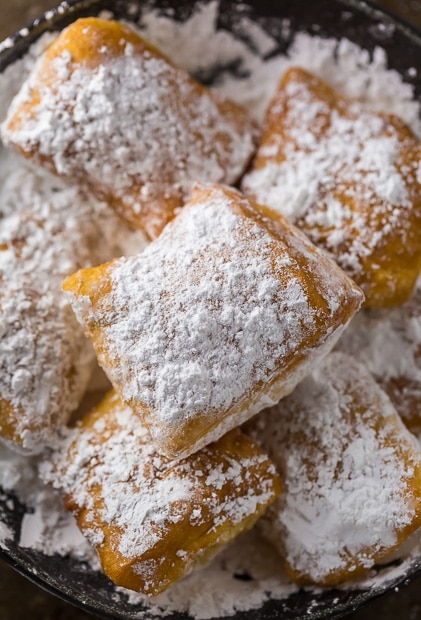
Copycat Café du Monde Beignets
We’re heading to New Orleans for vacation today and I couldn’t be more excited to chill out in the big easy! Give me all the fried dough, boozy iced coffees, and gumbo, please and thank you!
But before we head to the airport, I’m popping in to share my favorite deep fried beignets recipe with you. Aka copycat Café du Monde beignets, which are the best in New Orleans.
They fry up crispy, chewy, and golden brown! And you serve the beignets warm, covered in powdered sugar, with piping hot coffee. Sweet enough to be dessert but we love making these for breakfast or brunch!
What is a Beignet?
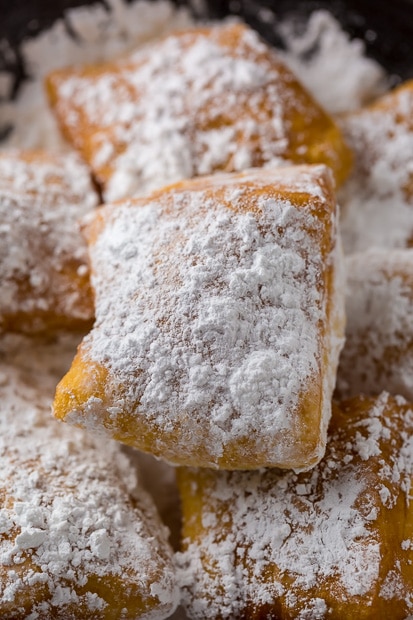
To put it simply, beignets are square shaped pieces of dough that are deep fried and generously sprinkled with confectioners sugar.
- Leftovers taste ok at room temperature, but they don’t hold up well over time.
- The word beignet is French, and translates to fried dough or fritter.
- Unlike traditional doughnuts, they have a unique square shape.
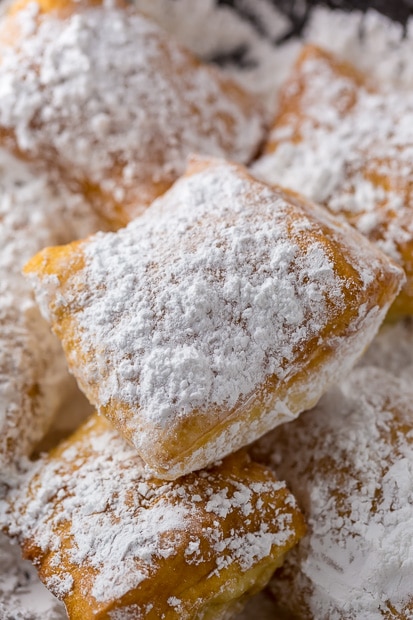
- Texture wise, they’re crispy on the outside, with an airy pillowy soft interior.
- When it comes to taste, they’re not overly sweet. Which is why they’re served covered in lots and lots of powdered sugar.
- Best served hot, with a cafe au lait or cup of coffee.
- You’ll need a deep fry thermometer for this recipe. Because if your hot oil temperature is off, your fried dough will be too. This is the candy thermometer I use, and I love it. It costs me less than 10 bucks, and I’ve probably used it over a hundred times!
- To proof the yeast mixture, your warm water should be between 110 and 115 degrees (F). If the water is too hot, it will kill the yeast cells, and if it’s too cold, the yeast will remain dormant and the dough won’t rise.
- This recipe requires bread flour. Bread flour is a high-gluten flour that has a tiny amount of barley flour and vitamin C added. The barley flour helps the yeast activate. The vitamin C increases the elasticity of the gluten and its ability to retain gas as the dough rises.
- The dough will double in size as it rests. Refrigerate the dough for at least 2 hours so it has time to properly develop.
- Fry the dough working in batches. If you crowd the oil, the beignets won’t get crispy or golden brown.
How to Serve Beignets
- As soon as you see the fried dough has achieved a golden brown color, remove them from the oil.
- Transfer them to a paper towel lined baking sheet to absorb some of the oil.
- Once cool enough to handle, transfer them to a large platter.
- Cover with powdered sugar and serve beignets warm!
As mentioned a few times earlier, I don’t suggest saving these for a future use. They get soggy after a few hours. So they’re best eaten right after making!
More Beignet Recipes:
If you can’t make it to New Orleans this year to enjoy cripsy golden brown fried dough… give it a try at home! Full step-by-step recipe video in the recipe card below!
New Orleans-Style Beignets
Ingredients
- 1 and 1/2 cups warm water, between 110 and 115 degrees (F)
- 2/3 cup granulated sugar
- 2 and 1/4 teaspoons active dry yeast
- 2 large eggs, at room temperature
- 1 cup evaporated milk
- 2 and 1/2 teaspoons pure vanilla extract
- 7 cups bread flour
- 1 and 1/2 teaspoons salt
- 5 tablespoons unsalted butter, at room temperature
- 4 cups peanut oil, for deep frying
- 2 cups confectioners’ sugar
Instructions
- In a medium-size bowl, add the warm water, sugar, and yeast and whisk well to combine. Sit aside for about 10 minutes, or until the mixture has bubbled up and become foamy.
- In the bowl of a stand mixer fitted with the paddle attachment, beat the eggs until smooth. Beat in the vanilla and evaporated milk. Beat in 3 and 1/2 cups of the flour until smooth. Turn the mixer to low speed and slowly pour in the yeast mixture (careful here – this mixture can splash up if added to quickly!); beat until smooth. Add in the butter and beat until incorporated. Finally, beat in the remaining 3 and 1/2 cups of flour and salt. Beat until dough is smooth and cohesive; about 2 minutes. Cover the bowl tightly with plastic wrap and refrigerate the dough for at least 2 hours, or up to 24 hours.
- Line a large rimmed baking sheet with three layers of paper towels, set aside.
- In a large enameled cast-iron pan, heat 4-inches of oil to 360 degrees (F). Remove the dough from the refrigerator. On a lightly floured surface, roll the dough out into a 1/4-inch thick rectangle. Cut the dough into 2 and 1/2-inch squares.
- In batches, fry the dough until they puff up and are golden brown in color, about 1 minute. Using a slotted spoon, transfer the beignets to the prepared baking sheet and repeat with remaining dough.
- Dust with powdered sugar and serve at once!





A couple of thoughts… You can use any pan deep enough to allow the oil to float the beignets. The reason a cast iron pan is recommended is that cast iron heats more evenly than most and retains the heat better so you get a more uniform and reliable fry. Monitor the temperature as you cook because every time you add a new lump of dough the temperature will drop a bit and needs to recover. Again, that fluctuation is dampened if you use cast iron.
It is mentioned in the commentary, but I will restate… using bread flour provides a dough with more gluten in it which makes a somewhat chewier dough that also retains gas better to keep them puffy. You can use All Purpose flour but the texture will not be the same.
Yeast is a living thing that becomes active when you provide liquid and food (flour and sugar). Part of the byproducts of the yeast growing and reproducing are flavors that are created as the yeast digest the other ingredients. At room temperature the yeast will consume ingredients at a particular rate and give off the desired flavors. When you put the dough in the refrigerator, the yeast activity slows down and the various reactions will also be affected. The result can be what most people would call desirable flavor shifts that deepen and smoothen out the flavor profile. Either result will be just fine.
I hope that answers some questions that have been posted here. It is all part of the science of cooking and just shows that there are often reasons why things are done in a particular way to get the expected results. Making your own tweeks is perfectly acceptable but will affect the final outcome.
REALLY EVERYONE??? I can’t believe that people really don’t take the time to re-read something that they have right in front of them before asking.. It’s common sense to check the complete recipe and voila your question doesn’t need asking.
That’s THE main reason why recipes don’t work. READ the INGREDIENTS LIST then read the instructions so you know HOW to put the ingredients together. EGGS are listed as an ingredient as everyone stated then you argued that they weren’t there. Silly!!!
LOVED THE BEIGENTS
Wondering if you can use an Air fryer for these?
Does the dough rise when it’s put in the fridge for 2 hours? Or is the rising of the dough not important for this recipe?
Can you freeze and thaw these?
Can I use milk instead of evaporated milk?
I’ve made this recipe several times and each was successful. I substitute the evaporated milk with coconut milk because of a dairy allergy in the family but it doesn’t seem to hurt the taste or texture.
This recipe makes a lot of beignets. I cut the dough and then freeze the extra pieces. I’ve tried defrosting first and also not defrosting them. There was no difference. Frozen handles a little easier. I’ve stored them for as much as two months.
I’m curious when you say you froze the extra pieces …Do you mean you rolled it all out and cut into pieces ready to fry and yet froze them cut up and ready? And if so did you single layer them and freeze them separately?
How long do these keep?
What if you don’t have a stand mixer?